Homebirth isn't brave
you're not really even being brave, you've sanded down the noise and listened to the bat signal, you're remembering what your body already knows


We need to retire the word brave. I know, I know - you hear it all the time. Like, oh my god, Becky, you're so brave. People say it like you're climbing Everest in flip-flops, or like you've got steely nerves, rah-rah grit, and a death wish wrapped in a paper gown.
What they're really trying to say is "I'm afraid that wouldn't be safe for me." And that's okay, really, it is. That's their truth, their understanding of reality. But it's not yours, is it?
Being brave pretty much just means you're scared but you do it anyway. White knuckling it through. Fighting gravity and your own nervous system and pretty much everything everyone ever told you was dangerous.
Brave is for the ones who leap without looking, or the ones, like me, who walk off the edge of a 30-ft tower into the blackness of night, deep in the starlit mountains of Colorado, relying solely on ropes and hope, while the bears carve the trees you can't see.
Then there's you... oh beautiful you... you leaped and you looked. You did both because being thorough is what you've been taught. You looked longer and harder and more honestly than most people in your life will ever know.
But the longer you looked, the more you've sat with the pros and the cons, the inner examinations and the outer research, the less it felt like courage and the more it felt like something older than courage. Like memory. Like the body recognizing something it was never actually taught.
There's a difference between the two, and it's a bigger difference than it initially sounds.
Before You Birth
The Confidence Guide
Before You Birth: The Confidence Guide is for the woman who's already done the research and still can't shake the feeling that something might go wrong. Written by Dana Daisi, who caught her own 13.2 pound baby on her bedroom floor with nothing but garbage bags, old sheets and a body she'd learned to trust, this guide walks you through the borrowed fear you've been carrying and the practical, physiology-backed practices that teach your nervous system what calm actually feels like before labor starts. What you'll walk away with is confidence built quietly, practiced daily, long before your first contraction.
Format: PDF, 130 pages + pictures
Buy Now - $37.00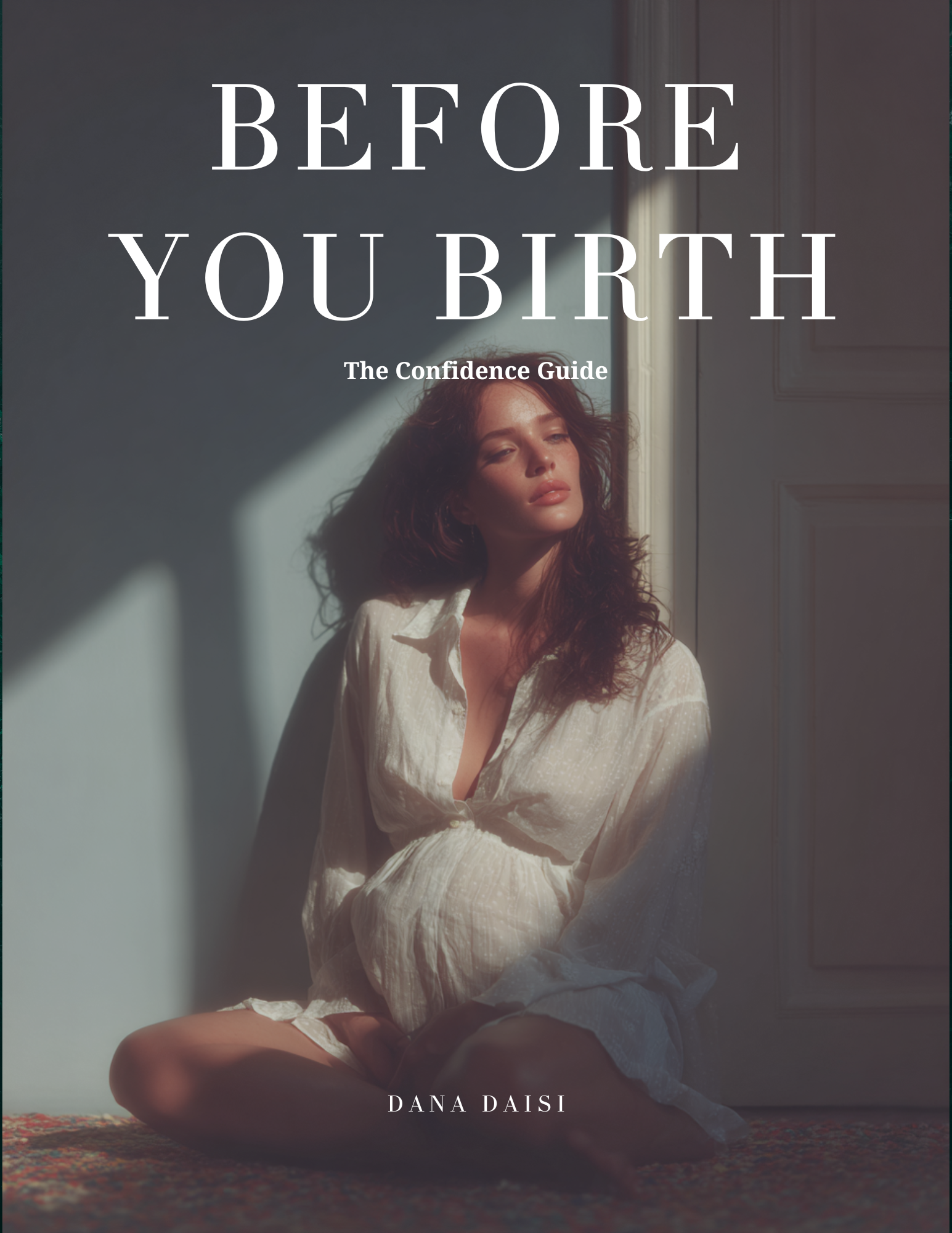
Brave is romantic and uncomplicated. It's what they write about in trilogies and put in the mouths of men on wild horses in movies we haven't watched since the nineties.
Informed is something else entirely. It's you, cross-legged at midnight, learning about infection rates and maternal mortality and how the biggest risk factor for a negative birth outcome isn't sitting on the couch in your living room. It's the white coats who've never watched a woman have a baby without their help and then hurried to compile all the "she did this wrong" data. It's the shadowy act of handing your sovereignty to someone with a clipboard and a liability form and calling that safety.
But underneath the research, underneath all that reading, something deeper was happening - the familiar, the knowing, the inner nudges and new trains of thought that say, "I'm not doing this because I'm brave. I'm doing this because I read the thing, and then I read it again, and then I sat with what I found until it stopped scaring me and started making sense."
Think about what you're actually doing when you choose homebirth. You're making a silent claim about epistemology, about whose knowledge gets to count and reign supreme. You believe that the feedback your body gives you matters, that your very real and present sensory reality matters, that open-minded research matters, that your partner's peaceful presence matters.
And you've learned that oxytocin - the hormone that floods your nervous system differently in the warmth of your own bed, in the glow of your own candles, in the smell of your own home - matters more than the sterile, lifeless choreography of a delivery room.
So you're not really even being brave here, you're being smart and wise, you're remembering what your body already knows.
You've read Ina May's Spiritual Midwifery and learned that the vagina isn't a dangerous passage that needs management. It's a passage that has been doing this since before anyone thought to write it down.
You've read the MANA statistics. You learned that home and birth-center births had lower intervention rates and better maternal outcomes than hospital births for low-risk pregnancies. That's not a fringe finding. That's data. The same kind of data they would cite at you if it ran the other direction.
You've read about the cascade of interventions - how one monitor leads to one restriction, which leads to one drug, which leads to one surgery - and suddenly you're having an experience that nobody designed with you as the focus. And somewhere in that flow of perceived control, the woman - you - who was supposed to be the center of this remarkable story has become the patient in someone else's.
And then you read about the vagus nerve. How your nervous system runs on two main channels: sympathetic (fight, flight, freeze) and parasympathetic (rest, digest, release). How labor needs the second one to function properly. How a familiar environment, low lighting, voices you trust, a bed where you've made love - these aren't luxuries. They're nervous system alchemy, your body's permission slip to do the work it knows how to do.
You read about the mammalian brain. How it can't birth effectively when the neocortex is hijacked by the overlords of surveillance and scrubs colored in fear. Midwifery even has a name for it - "the privacy that labor needs," and goes on to say that it's not just a preference, it's a prerequisite, a necessary one-step-in-front-of-the-other for birth to unfold naturally and instinctively. This is purely physiological, with a slight side of mysticism as well. Your amygdala quiets down when you feel safe and at ease, your oxytocin rises, your contractions become effective.
This isn't crystals and woo-woo intentions and chanted songs of Kumbaya. This is Bruce Lipton territory, where your environment literally, and figuratively, shapes your gene expression, your nervous system response, and the way your hormones move through you.
The hospital wasn't designed around your parasympathetic nervous system. It was designed around liability, efficiency, predictability and the comfort of everyone in the room... except you.
So when someone calls you brave, you can smile and nod, because you understand something they don't quite see yet. You're not being brave. You're being informed from a place of familiarity and knowing. You've sanded down the noise and listened to the bat signal. You've chosen a mirror instead of a snapchat filter. You're claiming sovereignty over your own becoming.
The world is loud about birth. It whispers danger from a thousand directions - your OB, your mother-in-law, your best friend who had a hospital birth and it was great (or it wasn't), the story about one bad outcome from someone's cousin's neighbor.
All of that noise gets into your bones and writes a story for you. Birth is risky. Birth is scary. Birth is something that happens to you, not with you and through you, managed by someone else's protocol while you comply from the table.
But you did something few people ever do.
You got quiet. The reading came next, past the noise, past the fear, past the stories that were never yours to carry. You asked your body a question women rarely think to ask and started to imagine a different outcome. A midwife entered the picture who looked at you and saw a Powerhouse instead of a risk profile. And somewhere in all of that, a different story became possible.
That's so much more interesting than brave.
The women who choose informed paths, the women who choose to get quiet enough to hear their own bodies, to become one with their knowing, who make choices from instinct rather than fear - those women are teaching their daughters and their friends and everyone in their circle that there's another way. That you get to be the author of your own becoming. That sovereignty isn't selfish, it's purposeful, it's sacred.
So the next time someone calls you brave, receive it as the compliment it's intended to be. But you'll know something truer underneath: You're awake. You're familiar with what your body knows. You're sovereign. And you're never going to be able to unknow any of it.
-xoxoxo dana♡
Before You Birth
The Confidence Guide
Before You Birth: The Confidence Guide is for the woman who's already done the research and still can't shake the feeling that something might go wrong. Written by Dana Daisi, who caught her own 13.2 pound baby on her bedroom floor with nothing but garbage bags, old sheets and a body she'd learned to trust, this guide walks you through the borrowed fear you've been carrying and the practical, physiology-backed practices that teach your nervous system what calm actually feels like before labor starts. What you'll walk away with is confidence built quietly, practiced daily, long before your first contraction.
Format: PDF, 130 pages + pictures
Buy Now - $37.00